
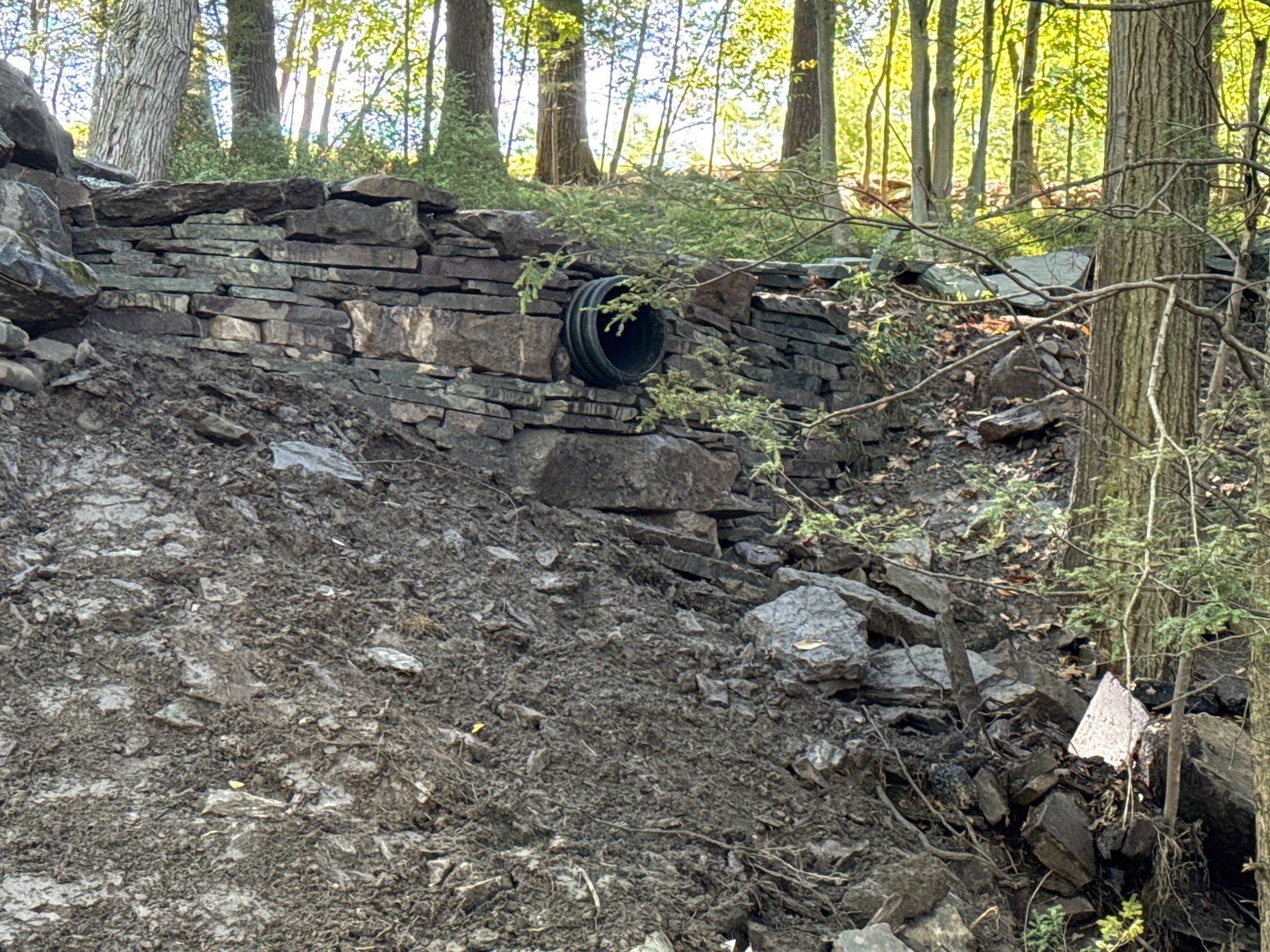
Water Directed Away from Structures Permanently
Drainage & Erosion Control Solutions in Honesdale and surrounding towns for properties experiencing foundation threats, landscape washout, or persistent standing water
Standing water that remains for days after rainfall, soil washing downslope during storms, and basement moisture appearing seasonally all indicate drainage failures that worsen over time. For Him Contracting addresses runoff and erosion issues throughout the Upper Delaware River Valley where slope conditions and clay-based soils create water movement challenges. French drains, grading adjustments, and subsurface drainage systems redirect water before it reaches foundations, saturates yards, or carves channels through landscaping.
Drainage solutions begin with identifying where water originates, how it travels across the property, and where it accumulates or causes damage. Grading improvements change surface elevation to direct runoff away from buildings, while French drains intercept subsurface water moving through soil layers. Each site presents different water sources including roof runoff lacking proper discharge points, upslope properties directing water onto lower parcels, and seasonal groundwater emerging at grade changes where soil layers meet.
Request a drainage evaluation to map water movement patterns and identify intervention points before damage expands.
How Drainage Systems Address Water Problems
Effective drainage uses gravity and soil permeability to move water toward planned discharge points rather than allowing random flow patterns to develop. French drains consist of perforated pipe surrounded by graded stone installed in trenches that intercept water traveling through soil, with depth and placement determined by where subsurface water moves and where it needs redirection. Surface solutions include swales that channel runoff, grading that creates positive drainage away from structures, and catch basins that collect water for underground conveyance.
After installation, previously saturated areas dry out between rain events, foundations no longer show moisture infiltration or efflorescence, and landscape areas stop eroding during storms. Water flows through designed channels and drains rather than pooling randomly, and outdoor spaces become usable after weather events instead of remaining muddy for extended periods.
Solutions integrate with existing site features and future improvements, with drainage planning often coordinating with hardscaping projects, foundation repairs, or landscape installations. Properties throughout the Northern Poconos face seasonal freeze-thaw cycles that require drain outlets positioned below frost depth to maintain function year-round, and slopes prone to erosion benefit from retaining walls that stabilize soil while drainage systems manage water contributing to instability.
Answers to Frequent Service Questions
Drainage and erosion control decisions require understanding how water behaves on your specific property and what interventions produce lasting results.
What causes water to pool in certain areas repeatedly?
Surface depressions collect runoff that has nowhere to flow, compacted soil prevents absorption forcing water to remain on the surface, high water tables cause saturation from below, and grading directing water from multiple sources toward low points creates accumulation that overwhelms natural drainage capacity.
How does a French drain differ from surface grading?
French drains intercept subsurface water moving through soil before it emerges or saturates an area, using perforated pipe and aggregate to collect and convey water below grade, while surface grading changes land elevation to redirect visible runoff before it enters problem areas.
When should erosion control be addressed?
Active erosion visible as channels, exposed roots, or sediment deposits indicates immediate need, but preventative installation makes sense before grading changes, landscaping projects, or construction that will alter existing water flow patterns and potentially create new erosion pathways.
What determines where drainage systems discharge water?
Discharge points must be lower in elevation than collection areas, located where released water won't cause problems for neighboring properties or structures, and positioned to utilize natural drainage corridors or existing stormwater infrastructure when available in developed areas of Milanville.
Why does seasonal groundwater require different solutions than surface runoff?
Groundwater emerges from soil layers where water tables intersect the surface or where less permeable layers force water upward, requiring subsurface interception and conveyance, while surface runoff responds to grading and containment that redirects flow before it concentrates or gains erosive velocity.
For Him Contracting designs drainage systems based on observed water behavior, site topography, and soil conditions specific to each property. Arrange a site visit to evaluate drainage concerns and develop solutions that protect foundations, landscaping, and outdoor functionality across your property.